Your One-Stop Shop for Engineering, Electromechanical & Construction Tools


Your One-Stop Shop for Engineering, Electromechanical & Construction Tools
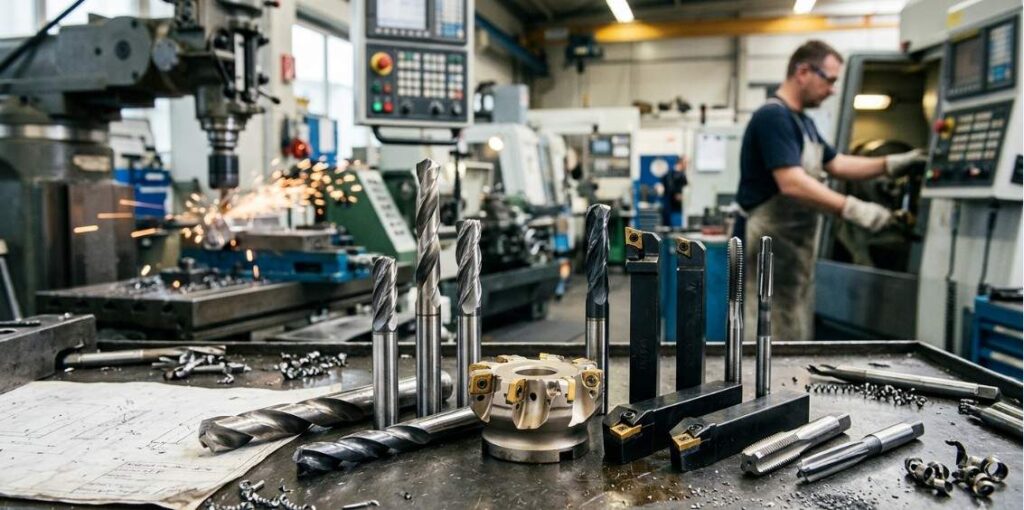
Cutting tools are the backbone of modern manufacturing, enabling precision shaping, machining, and finishing across industries such as automotive, aerospace, and construction. From simple hand tools to advanced CNC tooling systems, selecting the right tool directly impacts productivity, surface finish, and operational cost.
This beginner’s guide explains the types, materials, and real world uses of cutting tools, helping buyers and professionals make informed decisions aligned with performance and application requirements.
A cutting tool is a wedge-shaped device used to remove material from a workpiece through shear deformation. These tools operate under controlled conditions of speed, feed, and depth of cut to achieve the desired geometry and finish.
Common machining processes include turning, milling, drilling, and grinding. Each requires specialized tools designed for specific cutting conditions and materials.
Understanding different tool categories is essential for selecting the right solution for your application.
Single point tools are used primarily in turning operations on lathes. They have one cutting edge and are ideal for producing cylindrical shapes.
Examples include:
These tools are widely used in industries that require precision shafts and rotational components.
Multi point tools have two or more cutting edges and are commonly used in milling and drilling.
Examples include:
They offer higher productivity and better surface finishes compared to single point tools.
Indexable tools use replaceable inserts made from hard materials like carbide. These inserts can be rotated or replaced when worn out.
Leading manufacturers like Sandvik Coromant and Kennametal dominate this segment with advanced tooling solutions.
Benefits include:
The material of a cutting tool determines its durability, heat resistance, and cutting efficiency.
High speed steel cutting tools are known for toughness and affordability. They are suitable for low to medium speed operations. They are commonly used in workshops and maintenance environments where cost control is important.
Carbide cutting tools are widely used in high speed machining due to their hardness and wear resistance. They are ideal for machining hard materials such as stainless steel and cast iron while maintaining longer tool life.
Advanced materials like ceramics and cubic boron nitride are used for high temperature applications and hard machining. These tools are typically used in aerospace and automotive industries where precision and durability are critical.
Each machining operation requires specific tools and strategies.
Turning tools for lathe machines are used to remove material from rotating workpieces. They are essential for producing cylindrical parts such as shafts and bushings with tight tolerances.
Milling cutters types and uses vary based on geometry and function. Common types include end mills, face mills, and slot drills. Milling is widely used for creating complex shapes, slots, and surfaces.
Drilling tools in machining are used to create holes in materials. Twist drills are the most common type. Precision drilling requires proper tool selection, coolant usage, and speed control.
Grinding cutting tools are used for finishing operations where high surface quality is required. They are commonly used in tool sharpening and precision component finishing.
Selecting the right tool involves evaluating multiple performance parameters.
Cutting tools for metal machining must match the hardness and properties of the workpiece.
For example:
Cutting tool geometry explained includes rake angle, clearance angle, and edge preparation. Proper geometry ensures efficient chip removal and reduces tool wear.
Cutting speed and feed rate directly affect tool life and surface finish. Optimizing these parameters helps prevent overheating and improves machining efficiency.
Modern tools come with coatings such as TiN, TiAlN, and AlCrN to enhance wear resistance. These coatings significantly improve tool performance in high speed environments.
Cutting tools are used across various industries with specific requirements.
Used for machining engine components, transmission parts, and brake systems.Precision and repeatability are critical for mass production.
Requires high performance tools capable of machining titanium and composite materials. Tools must withstand extreme temperatures and maintain tight tolerances.
Industrial cutting tools applications include cutting structural steel, pipes, and heavy machinery components. Durability and reliability are essential in harsh environments.
Even with advanced tools, machining operations face several challenges.
Excessive wear reduces accuracy and increases costs.
Solution:
High temperatures can damage both tool and workpiece.
Solution:
This can result from incorrect tool selection or parameters.
Solution:
Understanding the basics helps avoid costly mistakes and improves machining outcomes.
The cutting tool industry is evolving with advancements in materials and digital manufacturing.
Common tools include drills, end mills, and turning tools used for shaping, cutting, and finishing materials. They are essential in industries like automotive, aerospace, and metal fabrication.
Select based on material type, cutting speed, and required finish quality Tool geometry and coating also play a key role in performance.
Carbide tools offer higher hardness and longer life for high speed machining. HSS tools are more affordable and suitable for lower speed operations.
Use proper speeds, feeds, and cooling techniques during machining. Regular inspection and correct storage also help prevent premature wear.
Cutting tools are essential assets in any machining environment, directly influencing accuracy, efficiency, and overall production quality. A clear understanding of tool types, materials, and applications enables businesses to select the right solutions for specific operational needs while minimizing wear, downtime, and costs.
As industries continue to demand higher precision and performance, choosing reliable tooling partners becomes equally important to ensure consistent results and long term value.
For businesses and industries in the UAE seeking high quality cutting tools and dependable industrial solutions, Al Sakeena Building Materials & Electricals Trading stands as a trusted partner for performance driven results.
Discover guides on all hardware, building materials, and electrical products for your next project.