Your One-Stop Shop for Engineering, Electromechanical & Construction Tools


Your One-Stop Shop for Engineering, Electromechanical & Construction Tools
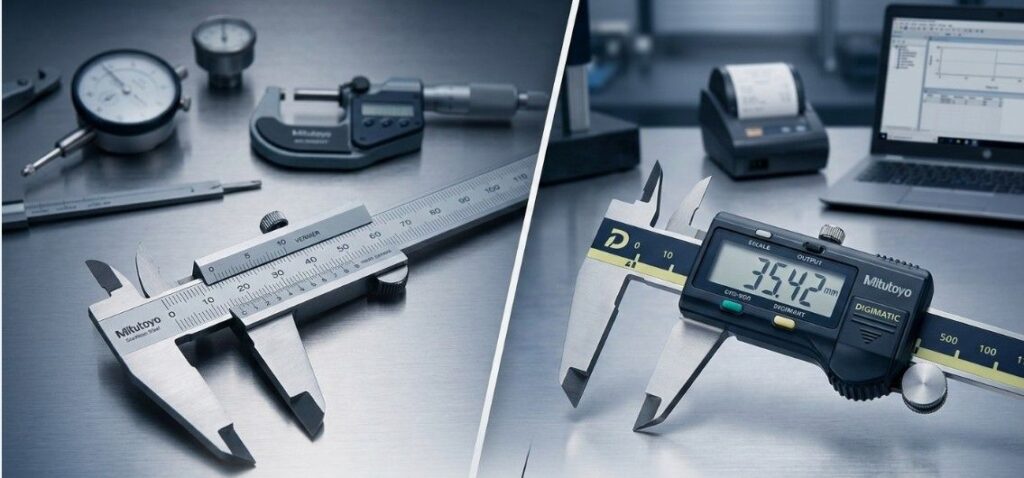
Precision measurement defines quality control in machining, fabrication, and industrial inspection across Dubai, UAE. Whether you operate a CNC workshop in Al Quoz or manage a calibration lab in Jebel Ali, choosing between analog and digital Mitutoyo instruments directly affects accuracy, workflow efficiency, and compliance.
But what is the real difference between analog and digital Mitutoyo instruments, and which one delivers better performance? This guide explains the technical, operational, and commercial differences between Mitutoyo measuring instruments, helping engineers, QA inspectors, and procurement teams make confident, application based decisions.
Analog instruments use mechanical movement and a graduated scale to display measurements. Common examples include analog vernier calipers, dial indicators, and micrometers.
They operate without batteries and rely on precision ground gears, rack and pinion systems, or screw threads to translate linear movement into readable values.
Digital instruments use electronic sensors and LCD displays to present measurements instantly. Popular options include Mitutoyo Digimatic Calipers, digital micrometers and height gauges.
They offer direct numerical readouts, minimizing interpretation errors and speeding up inspection processes in quality control departments.
Understanding the functional differences helps align your purchase with operational needs.
Both analog and digital Mitutoyo tools deliver exceptional precision. However, measurement accuracy is often easier to interpret on digital displays, especially for less experienced operators.
Digital models commonly offer higher resolution increments, making them ideal for tight tolerance machining and aerospace components.
Digital instruments provide instant readings on LCD screens, reducing fatigue during repetitive inspection tasks. This is especially beneficial in high-volume Dubai CNC and machining facilities.
Analog tools require manual interpretation, which may slow down workflow but provides tactile mechanical feedback valued by experienced machinists.
Analog tools typically withstand shock and contamination better. In high dust UAE fabrication settings, they remain dependable without concern for circuit damage.
Digital tools are engineered with protective sealing, but extreme moisture or impact may affect internal electronics if not handled properly.
Digital instruments excel in modern quality systems. For facilities following ISO or API standards in Dubai, digital connectivity supports calibration logs and production records.
Analog tools lack direct data output, meaning measurements must be recorded manually.
Digital models allow instant switching between inch and millimeter, a major advantage in UAE workshops handling mixed international specifications. Mitutoyo’s absolute inside Caliper Cont system maintains zero position even after power off, eliminating repeated recalibration.
Analog tools require manual calculation for conversions and physical resetting.
Digital tools require battery replacement, though Mitutoyo models offer long battery life.
Analog instruments operate without power and are always ready, making them reliable backup tools in demanding environments.
Analog instruments usually cost less upfront and require minimal maintenance beyond periodic calibration.
Digital models have a higher purchase price but offer productivity gains and reduced error rates, which can offset initial investment in high volume production environments.
| Feature | Analog Mitutoyo Instruments | Digital Mitutoyo Instruments |
|---|---|---|
| Display Type | Vernier scale or dial based mechanical reading | LCD electronic display |
| Reading Speed | Slower, requires manual interpretation | Instant numeric reading |
| Measurement Accuracy | High accuracy but depends on operator skill | High accuracy with reduced human error |
| Unit Conversion | Manual conversion required | Instant inch/mm switching |
| Zero Setting | Manual reset required | Absolute encoder retains zero position |
| Data Output | No SPC data output | Supports SPC data transfer |
| Durability | Highly resistant to shock, oil, and coolant | Durable, IP67 models available for coolant protection |
| Power Requirement | No battery required | Requires battery |
| Best For | Rugged workshops, field work, heavy fabrication | CNC machining, QA labs, high-volume production |
| Upfront Cost | Lower initial cost | Higher initial cost |
| Long Term Efficiency | Long mechanical lifespan | Faster workflow and documentation efficiency |
In CNC environments where tolerances are extremely tight, digital micrometers and calipers provide fast verification. Reduced reading error supports consistent batch production.
However, experienced machinists may still use analog dial indicators for setup alignment due to immediate visual response.
Components such as flanges and valves require reliable dimensional inspection. Analog instruments perform well in rugged conditions, while digital systems enhance quality reporting.
Selecting the right tool depends on whether field durability or documentation automation is prioritized.
Controlled environments favor digital tools. Clean rooms and metrology labs in Dubai benefit from electronic readouts and automated data capture.
Here, the balance shifts toward digital precision and reporting capability rather than mechanical simplicity.
Both analog and digital instruments require periodic calibration to maintain compliance with international standards.
In UAE industries governed by ISO 9001 or similar frameworks, maintaining traceable calibration certificates is essential for audit readiness and customer confidence.
Analog tools may need mechanical adjustments over time, while digital models require battery monitoring and occasional sensor inspection.
Choosing between Analog and Digital Mitutoyo instruments depends on speed and convenience versus durability and budget. While Mitutoyo is respected for quality across both formats, digital models, especially the Absolute Digimatic series, are widely preferred in modern fast paced production settings, while analog excels in rugged or coolant heavy environments.
Pick Digital if:
Pick Analog if:
This blog explains the key differences between analog and digital Mitutoyo instruments, highlighting aspects such as measurement accuracy, durability, ease of use, cost considerations, and guidance for application-based selection.
Both provide high precision, but digital instruments reduce reading errors with clear numeric displays. Accuracy depends more on calibration and handling than display type.
Yes, many models are sealed for industrial use, but extreme dust or impact requires careful handling. Analog tools may be more rugged in harsh environments.
They require battery checks and periodic calibration like analog tools. Proper storage and handling extend lifespan significantly.
Digital instruments are better for automated data logging and SPC integration. They simplify audit compliance and traceability requirements.
Choosing between analog and digital Mitutoyo instruments depends on your environment, inspection speed, and documentation needs. Analog tools excel in rugged, coolant-heavy Dubai workshops where durability matters most, while digital instruments enhance productivity, accuracy, and SPC integration in modern CNC and quality control environments.
For authenticated Mitutoyo instruments, expert verification support, and procurement guidance tailored to engineering, manufacturing, and oilfield applications across the UAE, trust Al Sakeena Building Materials and Electricals Trading to deliver precision tools that perform flawlessly in every environment.
Contact our Mitutoyo tool specialists for personalised instrument recommendations, certified calibration support, and dependable supply.