Your One-Stop Shop for Engineering, Electromechanical & Construction Tools


Your One-Stop Shop for Engineering, Electromechanical & Construction Tools
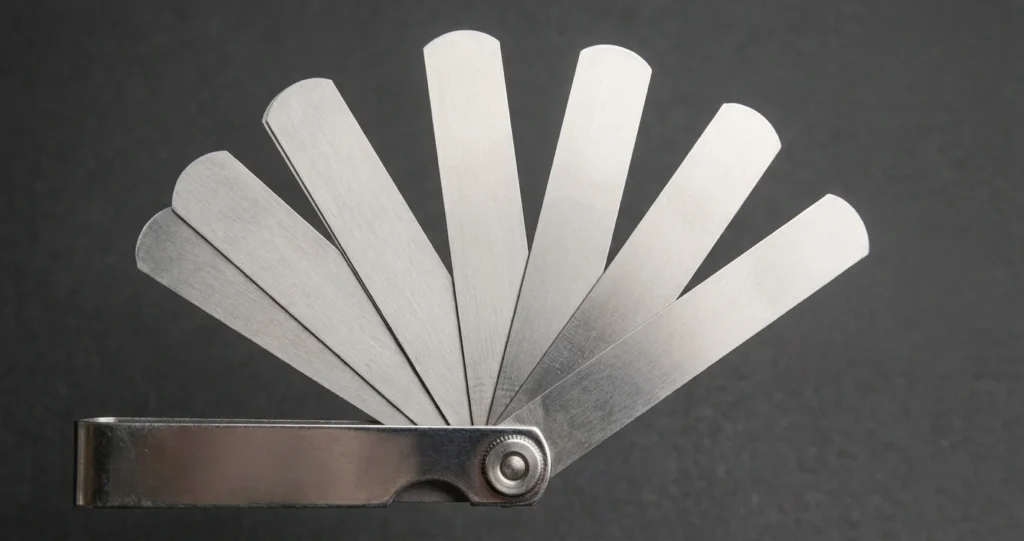
A feeler gauge is a set of thin steel blades of known thickness, used to measure small gaps and clearances between two parts. This guide explains what is a feeler gauge, where it is used, the main types, how to measure with one step by step, what least count means and how to choose and care for a set.
If you have ever tried to check a gap thinner than a business card, you already know a ruler is no help. That is the exact problem a feeler gauge solves. So, what is a feeler gauge, and why does almost every workshop, plant room and maintenance team keep one close by?
This guide covers how the tool works, where it is used, the main types, how to read it and how to pick the right set. It is written for technicians, buyers and anyone who wants accurate clearance checks without guesswork.
A feeler gauge is a set of thin metal blades, each marked with its thickness, used to measure small gaps between two parts. You slide blades into the gap until one fits with light resistance. The thickness printed on that blade is your clearance.
Most sets fold into a holder like a pocket knife, so the blades fan out when you need them. Common sets start at around 0.02 mm to 0.05 mm and go up to about 1 mm, and some reach 5 mm. Blades are usually hardened or stainless steel so they keep their size over time.
The idea is simple. The skill lies in knowing what a correct fit feels like, which comes quickly with practice.
A feeler gauge is used wherever a small clearance affects how a machine runs, wears or seals. Common jobs include engine valve clearance, spark plug gaps, bearing and piston ring clearances, machine tool setup and electrical contact gaps. If a manufacturer lists a gap in millimetres, this tool usually checks it.
Here are the most common uses.
Getting the clearance wrong has real costs. A gap that is too tight can cause overheating and early wear. A gap that is too loose brings noise, vibration and poor sealing.
Feeler gauges differ mainly by blade design, measurement range, material and access requirements. Standard blade sets are the most common, while offset, wire, taper and non-metallic versions are selected when the working area or application requires a different approach.
Blade feeler gauges contain multiple flat metal leaves mounted inside a hinged holder. Each blade is marked with its thickness, allowing the user to select individual blades or combine several blades when a particular clearance falls between available sizes.
This is the general-purpose option for workshops and maintenance teams because one compact set can cover many measurements.
Offset or angled blades are useful when a straight blade cannot reach the measurement point properly. The bent profile allows technicians to approach gaps around housings, engine components and other restricted areas.
The main advantage is access. The measurement principle remains the same, but the blade geometry makes it easier to work around obstructions.
Wire-type gauges use calibrated wires instead of flat blades. They are commonly associated with applications such as spark plug gap checking, where the rounded wire can be positioned between two electrodes.
They are particularly useful when the shape of the gap makes a flat blade inconvenient.
Taper gauges gradually change thickness along the measuring section. They can be useful for checking larger or varying clearances because the technician can insert the blade until the required resistance is reached and then read the corresponding thickness.
Plastic gauges can be useful when electrical conductivity, corrosion or scratching is a concern. They are not as durable as hardened metal blades, so the material should be selected according to the application rather than simply choosing the cheapest option.
To measure with a feeler gauge, clean both surfaces, pick a blade close to the expected gap and slide it in gently. Move up or down in thickness until one blade drags slightly. That blade’s thickness is the gap. If the next size up will not enter, you have your reading.
Follow these steps for a reliable result.
Never force a blade or bend it to get it in. If no single blade matches, you can stack two, but use as few as possible because each extra blade adds a small error and can trap dirt.
Least count is the smallest thickness difference a feeler gauge can show, and for most sets it falls between 0.02 mm and 0.05 mm. A finer least count suits CNC setup and precision assembly. Accuracy also depends on blade condition, cleanliness and how much pressure you apply.
A feeler gauge is a touch based tool, so two people can read the same gap slightly differently. For most workshop jobs that is fine. When a tolerance is tighter than the blade steps in your set, a dial gauge or micrometer is the better choice.
Temperature matters too. Check clearances at the condition the manufacturer specifies, whether that is a cold or warm engine or a machine at rest.
Choose a feeler gauge by matching its thickness range, unit system, blade material and blade length to your job. Pick a set that covers your smallest and largest clearance with a few sizes to spare. Buying for the narrowest gap you work with usually saves you from reordering.
Use this quick checklist.
A full set is usually better value than single blades, since you will test several sizes in most gaps. Single replacement blades are handy when one gets damaged.
Wipe each blade clean after use, add a thin film of light oil and fold it back into the holder. Store it dry and away from heavy tools. Check blades regularly for rust, kinks and worn markings, and replace any blade that no longer sits flat.
A bent or rusty blade gives a false reading, and that false reading carries straight into your setup. A few seconds of care after each job keeps the set accurate for years.
So, what is a feeler gauge? It is a small, simple tool that gives you a trusted reading on gaps that decide how well a machine runs. Know the types, learn the feel of a correct fit, keep the blades clean and choose a range that matches your work.
If you need a dependable source for measuring tools, Al Sakeena Building Materials and Electricals Trading supplies measuring tools, building materials and electrical products to workshops, contractors and industrial teams. Its team can help you match the right set to your application.
Get the right feeler gauge for your workshop
Not sure which blade range, material or length suits your clearance checks? Tell our team what you are measuring and we will recommend the right set. You get clear advice and a straightforward quote, with no guesswork.
Each blade has its thickness marked on it, in millimetres, inches or both. Slide blades into the gap and move up in size until one drags slightly. The marking on that blade is your reading. The next size up should not enter.
The least count is the smallest thickness difference the gauge can show. Most standard sets have a least count between 0.02 mm and 0.05 mm, depending on the quality and design of the set.
Yes. Feeler gauge, gap gauge and thickness gauge are different names for the same tool. All of them use thin blades of known thickness to measure small gaps. The name you see usually depends on the trade, the region or how the supplier lists the product.
Discover guides on all hardware, building materials, and electrical products for your next project.