Your One-Stop Shop for Engineering, Electromechanical & Construction Tools


Your One-Stop Shop for Engineering, Electromechanical & Construction Tools
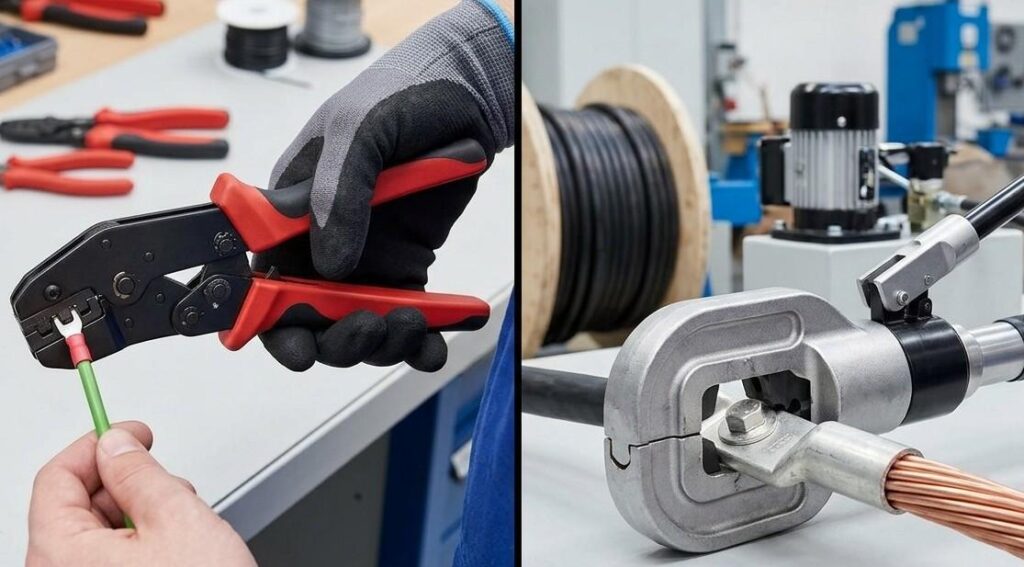
Crimping is one of the most trusted methods for creating secure, long-lasting electrical and mechanical connections. From wiring a residential panel to terminating heavy industrial cables, the quality of your crimp directly determines the safety of the entire connection.
One of the most common questions professionals and beginners ask is whether to use a manual crimping tool or a hydraulic one. Both can produce excellent crimps, but they are built for very different demands and workloads.
The wrong choice leads to operator fatigue, inconsistent results, and failed inspections. This guide breaks down everything you need to know so you can choose with confidence.
A manual crimping tool is a hand-operated device that uses the operator’s physical force to compress a connector or terminal onto a wire. Most models feature a pliers-like design with long handles that create mechanical leverage at the jaws.
Many models include a ratcheting mechanism that prevents the tool from releasing until the crimp cycle reaches full depth. This eliminates under-crimping and produces more consistent results across repeated use.
Manual crimpers are available in several styles to suit different applications:
The biggest appeal of manual tools is their simplicity. They need no power source, no hydraulic fluid, and almost no maintenance beyond occasional ratchet lubrication.
However, manual crimping tools have a hard physical limit. As wire gauge increases, the force required to make a proper crimp increases rapidly. Beyond around 16mm² to 35mm², human hand strength simply cannot deliver what the connection requires.
A hydraulic crimping tool uses pressurized fluid to generate the force needed to compress a connector onto a conductor. The principle is Pascal’s Law: pressure applied to confined fluid transmits equally in all directions, turning a small input force into enormous output force at the die head.
In real-world terms, this allows an operator to generate 6 to 12 tons of crimping force with a compact hand pump or a single trigger press. That level of force is what makes hydraulic tools essential for medium and large conductor work ranging from 35mm² all the way through 750 MCM.
Hydraulic crimping tools come in three primary configurations:
Most hydraulic crimpers also feature an interchangeable die system. One tool body handles dozens of conductor sizes simply by swapping the die set, making hydraulic tools a strong long-term investment for any operation working across a wide cable range.
Maintenance is more involved compared to a manual tool. The hydraulic fluid level needs regular checking, die seats must be cleaned after each session, and die wear should be measured periodically to keep crimp diameter within specification.
Understanding the differences between manual and hydraulic crimping tools becomes far clearer when the key performance factors are laid out together.
| Feature | Manual Crimping Tool | Manual Hydraulic Crimper | Battery Hydraulic Crimper |
|---|---|---|---|
| Power Source | Operator hand strength | Hand pump | Lithium-ion battery |
| Crimping Force | Up to 1 ton | 6 to 12 tons | 6 to 12 tons |
| Max Conductor Size | Up to 16mm² or 6 AWG | Up to 400mm² or 750 MCM | Up to 400mm² or 750 MCM |
| Crimps Per Session | Unlimited | Unlimited | 150 to 200+ per charge |
| Speed Per Crimp | Fast (one squeeze) | Medium (8 to 15 pump strokes) | Fast (one trigger pull) |
| Operator Fatigue | High for large gauges | Low to medium | Very low |
| Crimp Consistency | Operator-dependent | High with correct technique | Very high |
| Portability | Excellent | Good | Good |
| Maintenance | Minimal | Moderate (hydraulic system) | Moderate (battery and hydraulic) |
| Typical Cost | Low | Moderate | Higher |
| Best For | Small gauge, low volume | Field work, medium to large gauge | High-volume or production work |
A manual crimping tool transfers the operator’s hand strength through mechanical leverage directly to the crimp jaws. The output force varies with fatigue and technique, which means results can shift across a long workday.
A hydraulic crimping tool removes that variability entirely. The hydraulic system multiplies force by a fixed ratio on every single crimp, regardless of who is using the tool or how far into the shift they are.
This consistency is why hydraulic systems are the standard in:
Manual and hydraulic crimping tools are each built for a specific conductor range, and understanding that range is the most important factor in choosing correctly.
Manual crimping tools are best suited for:
Hydraulic crimping tools are required for:
Trying to crimp large conductors with a manual tool does not just produce poor results. It creates under-compressed connections that generate heat, increase resistance, and eventually fail in ways that present serious safety risks.
Manual crimping tools are genuinely simple to operate. Load the terminal, position the wire, squeeze the handles until the ratchet releases, and the crimp is complete. There is no setup time and no learning curve beyond matching die position to terminal size.
Hydraulic crimping tools require more attention to process. Before every crimp, the operator should:
None of this is complicated, but it does require consistent habits and a short learning period for new operators. Battery-powered models are the most user-friendly in the hydraulic category since the motor handles all pumping automatically.
A ratcheting manual crimper produces reliable crimps within its designed conductor range. The ratchet mechanism ensures the jaws reach the required closure depth on every cycle, which removes one of the main sources of inconsistency found in basic squeeze-style tools.
Beyond that range or across a high-volume workday, manual tools begin to show their limitations:
Hydraulic crimping tools produce what the industry calls a mechanically consistent indent crimp. The dies compress the connector from multiple sides simultaneously at controlled pressure, creating a gas-tight connection that meets dimensional tolerances required by connector manufacturers and standards such as UL 486A/B.
Every crimp across a production run looks and measures the same because the hydraulic system delivers the same force each time.
Manual crimping tools are the clear winner on portability. A typical ratchet crimper weighs between 500 grams and 2 kilograms, fits easily in a tool pouch, and requires nothing else to function.
This makes them ideal for electricians and technicians moving across multiple locations throughout the day.
Key portability advantages of manual tools include:
Hydraulic crimping tools are heavier and bulkier by design. A handheld manual hydraulic unit weighs between 2 and 5 kilograms.
Battery-powered models offer the best field compromise, combining trigger-speed operation with the freedom of no power cord. For fixed workshop environments, portability is irrelevant since the tool stays in one place.
A manual crimping tool needs very little upkeep to stay in good working condition. Keeping the ratchet mechanism clean and applying lubricating grease occasionally is typically enough to keep it performing reliably for years of regular use.
Hydraulic crimping tools require a structured maintenance routine to stay accurate and safe. Key maintenance tasks include:
A neglected hydraulic crimper will produce inconsistent crimp diameters long before it fails visibly. Regular maintenance is not optional; it is what keeps every crimp within specification.
Manual crimping tools are accessible at a low entry price, making them practical for individual tradespeople, small shops, and occasional DIY work. There are no ongoing costs beyond the occasional replacement part or die set.
Hydraulic crimping tools represent a larger initial investment. Factors to consider when evaluating the total cost include:
Working with a reliable hydraulic crimping tools supplier that offers a complete ecosystem of compatible dies, accessories, and after-sales support significantly reduces the total ownership cost over the life of the equipment.
For high-volume operations, the speed and consistency gains of hydraulic tools quickly offset the higher upfront price through reduced labour time and fewer rework callbacks.
The decision comes down to three factors: the conductor sizes you work with most, the number of crimps you perform per day, and the environment where that work takes place.
Choose a manual crimping tool if:
Choose a hydraulic crimping tool if:
Within the hydraulic category, a manual hydraulic model suits field technicians and utility crews who need portability without battery dependency.
A battery-powered model suits production shops and high-volume assembly operations where trigger-speed operation reduces fatigue and shortens job completion time.
Many professional operations keep one of each type. A manual hydraulic model covers field calls and remote sites while a battery-powered tool handles shop volume. This combination addresses every scenario without compromising on portability or speed.
Even with the right tool, avoidable errors are responsible for a large share of crimp failures in the field. Being aware of them is the easiest way to prevent problems before they happen.
The most common mistakes include:
Catching any one of these mistakes before the connection goes into service is worth far more than the seconds it takes to check.
Choosing between a manual and hydraulic crimping tool depends on your conductor size requirements, daily workload, and the environment in which you operate. Manual crimping tools are ideal for light-duty applications such as residential wiring, control panel terminations, and low-volume field work where portability and simplicity are the priority.
Hydraulic crimping tools are the right choice for medium to heavy conductor work, high-volume production environments, and any application where consistent, measurable crimp quality is required by safety standards or project specifications.
Many operations benefit from using both types together to cover the full range of their wiring and termination needs.
For genuine crimping tools, expert product guidance, and dependable supply support, trust Al Sakeena Building Materials and Electricals Trading.
Visit our website or contact our technical sales team today for professional recommendations on the right manual or hydraulic crimping tools for your specific application.
Discover guides on all hardware, building materials, and electrical products for your next project.