Your One-Stop Shop for Engineering, Electromechanical & Construction Tools


Your One-Stop Shop for Engineering, Electromechanical & Construction Tools
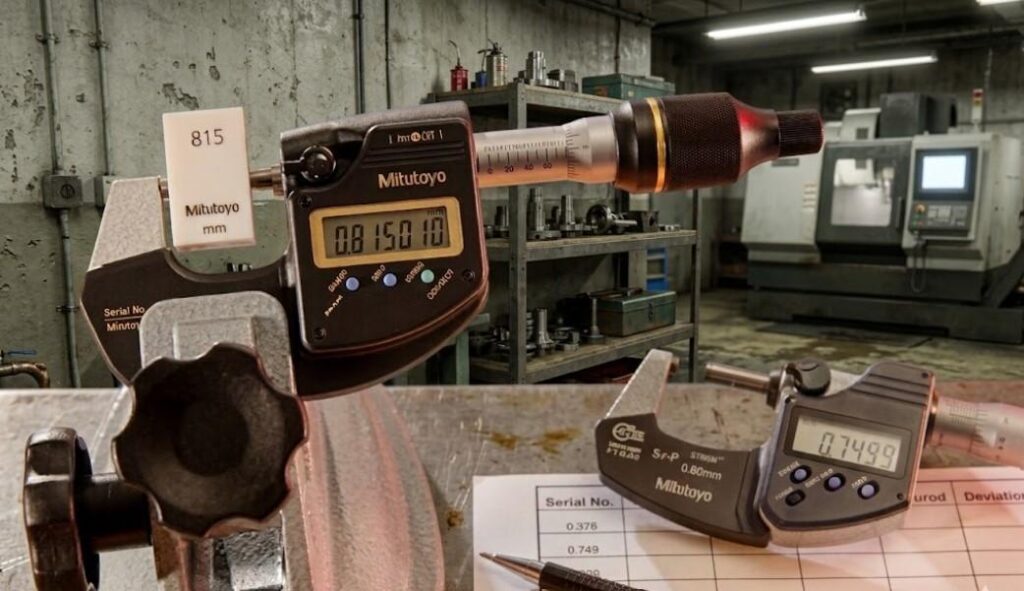
Calibration is a foundational process in precision metrology, especially for high-accuracy instruments such as those produced by Mitutoyo.
In industrial environments, even small calibration errors can lead to significant deviations in product quality, assembly failure, or non-conformance with international standards.
Calibration is essentially a structured process of identifying and minimizing measurement deviations while ensuring traceability and reliability of instruments. However, in real-world applications, several recurring calibration errors affect Mitutoyo measurement methods.
Calibration errors refer to the difference between a known reference standard and the reading produced by a measuring instrument. In Mitutoyo measuring instruments such as calipers, micrometers, height gauges, and CMM systems, errors typically arise due to equipment, environment, operator, or methodological issues.
Calibration is not only about adjusting instruments but also about “searching for errors” in a controlled and traceable way, ensuring measurement quality and uncertainty control .
Below are the most common and critical calibration errors observed in Mitutoyo measurement instruments such as micrometers, digital vernier calipers, height gauges, and coordinate measuring systems.
One of the most frequent calibration errors is incorrect zero adjustment. If an instrument is not properly zeroed before calibration begins, all subsequent measurements will carry a systematic offset.
Even a small zero error can accumulate across multiple measurements, leading to large deviations in batch inspection processes.
Environmental conditions significantly influence calibration accuracy. Temperature, humidity, and vibration can all distort measurement results.
Precision instruments are typically calibrated at controlled temperatures (around 20°C), but industrial environments often deviate from this standard, introducing hidden calibration errors.
| Factor | Effect on Measurement | Control Method |
|---|---|---|
| Temperature | Causes expansion or contraction of metal parts | Maintain 20°C standard temperature |
| Humidity | Leads to corrosion or surface instability | Use controlled humidity storage |
| Vibration | Reduces repeatability and stability | Use anti-vibration tables |
| Air Drafts | Creates slight reading fluctuations | Use enclosed calibration area |
| Dust | Affects contact accuracy and zero setting | Clean instruments before use |
Mechanical wear is a critical issue in handheld Mitutoyo tools such as micrometers and calipers.
When measuring surfaces are worn, calibration results may appear correct initially but drift significantly during real usage.
Calibration accuracy depends heavily on the quality of reference standards. If the standards are not properly maintained or certified, calibration results become unreliable.
Each reference standard must be traceable to higher-level standards to ensure validity and consistency.
Human factors remain one of the largest sources of calibration error.
Even with highly advanced instruments, improper handling can completely invalidate calibration results.
All calibration results contain a degree of uncertainty. Misunderstanding or ignoring this uncertainty leads to incorrect conclusions about instrument accuracy.
According to metrology principles, uncertainty increases with each calibration step due to accumulated errors from standards and methods used.
Proper uncertainty analysis is essential for realistic calibration assessment.
Not all calibration procedures are equally effective. Poorly designed methods may fail to detect certain types of errors.
For example, advanced calibration guidelines emphasize designing calibration methods as a structured “search for errors” rather than a simple comparison process.
Thermal drift is especially critical in high-precision environments.
Even microscopic thermal expansion can introduce measurable errors in micrometer-level precision tools.
Calibration errors often arise due to poor maintenance practices.
Regular servicing is necessary to ensure calibration stability over time.
Calibrating instruments too infrequently leads to unnoticed drift and accumulated errors.
Organizations must establish calibration intervals based on usage intensity, environmental conditions, and criticality of measurement.
This blog explains top calibration errors in Mitutoyo measurement methods, including environmental, operator, and instrument issues, with solutions to improve accuracy and ensure reliable precision results.
Common calibration errors include improper zero setting, environmental variations, worn measuring surfaces, and operator mistakes.
The 4:1 rule means the accuracy of the reference standard should be four times better than the instrument being calibrated.
Systematic errors such as zero offset and consistent measurement bias can be corrected through calibration.
Maximum permissible error (MPE) is the largest allowed deviation between measured and true values.
Calibration errors in Mitutoyo measurement methods can significantly impact accuracy, quality control, and production reliability if not properly managed. Issues such as environmental instability, worn components, operator mistakes, and incorrect reference standards are among the most common causes of measurement deviations.
However, with proper calibration procedures, controlled environments, regular maintenance, and trained operators, these errors can be greatly reduced, ensuring consistent and precise results in industrial applications.
For businesses in Dubai and across the UAE, partnering with a licensed Mitutoyo supplier ensures access to genuine instruments, expert calibration support, and long-term measurement accuracy, helping industries maintain quality, efficiency, and compliance in every operation.
Contact our calibration experts for Mitutoyo instruments to ensure accurate results, expert support, and reliable long-term industrial performance.